Shoaib Bashir’s England selection was based on Ben Stokes’ reaction to a short Twitter video of him bowling to Alastair Cook in a county championship game. The video was circulated to coaches McCullum and Key, and they were ultimately persuaded to take Bashir on the winter tour of India. This has become a classic example of the England test team’s instinctive, contrarian approach to selection under Stokes, McCullum and Key.
Taking Bashir to the spin-friendly subcontinent in early 2024 was unexpected but not completely outrageous. It’s more surprising that since then he has become England’s first-choice spinner, playing 16 tests and taking a very respectable 58 wickets. Throughout this time Bashir has been unable to get into Somerset’s starting XI, facing competition from the ever-reliable Jack Leach. As a result, he has endured painful loan spells at both Worcestershire and Glamorgan, which included being hit for a record 38 runs in an over.
Ahead of two critical, era-defining series against India at home and Australia away in 2025/26, England seem curiously wedded to the idea of a first-choice spinner who can’t get into his county side. It’s the cost of his wickets that raise an eyebrow; before he took 9 in the match against a poor Zimbabwe team in May this year, Bashir averaged over 40 with the ball, at an economy pushing 4 runs per over.
To see whether there is any method behind the selection madness, it’s worth comparing Bashir to England spinners who have come before him. I have focused on what we might loosely call the modern era (1990s onwards), and on those who make it into England’s top 100 wicket takers (45 wickets or more). In all the following charts, low is good.
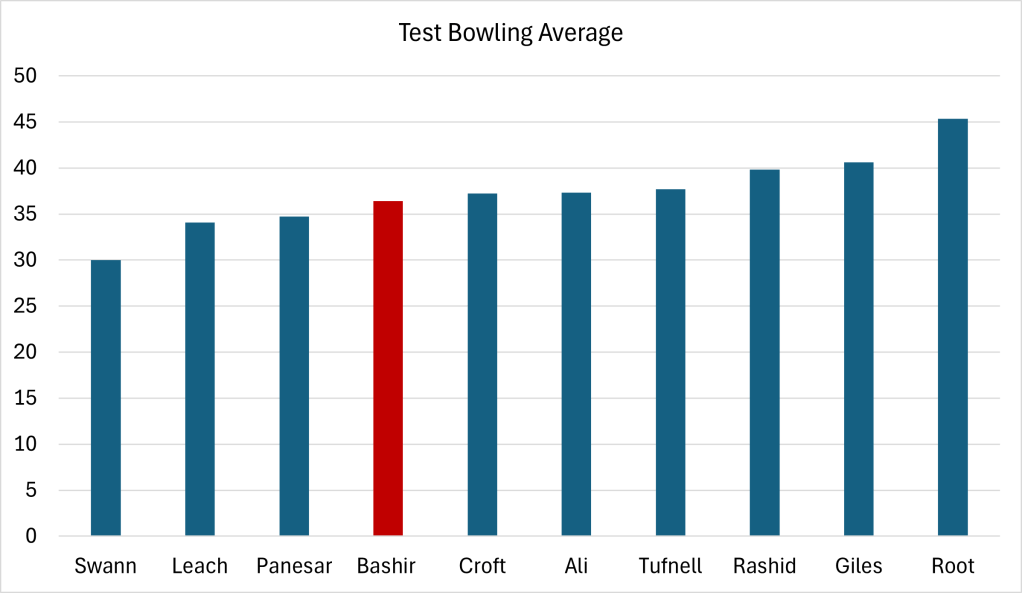
After his successful return against Zimbabwe to kick off the 2025 summer, Bashir’s test match bowling average (runs per wicket) is 36.39. This places him in respectable company alongside Robert Croft, Moeen Ali, and Phil Tufnell. The unlucky Jack Leach still does notably better, averaging 34 across twice as many matches. It’s easy to see why he gets the nod for Somerset. Prior to the Zimbabwe test, Bashir would have come in third from bottom.
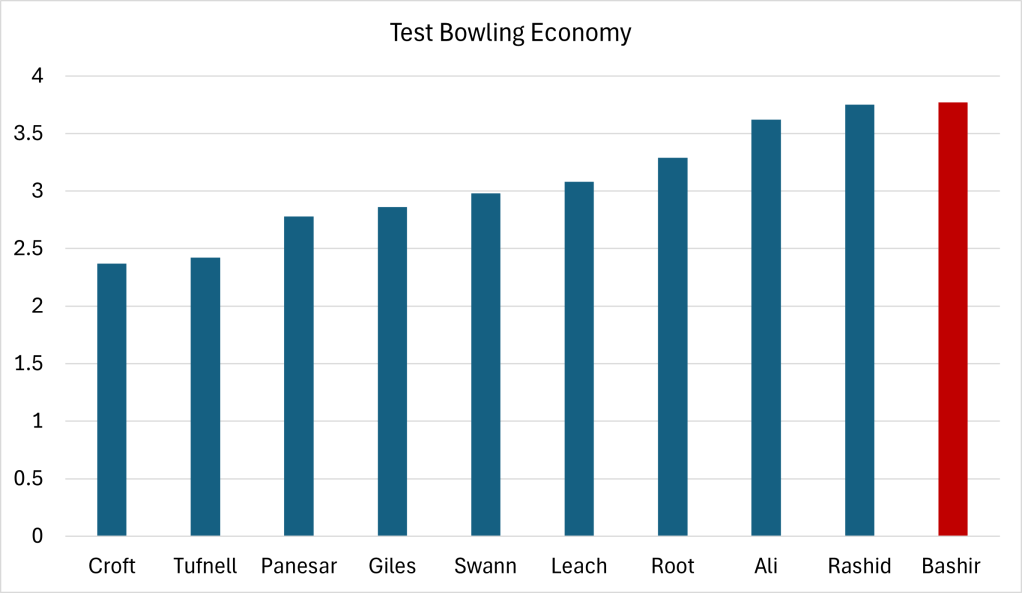
Comparing the same bowlers’ economy rates (runs per over) is just as illuminating. It’s clear that this is where Bashir struggles, ranking rock bottom, well behind part-timer Joe Root and alternative option Jack Leach.
Another relevant metric is a bowler’s strike rate, balls delivered per wicket taken. Bashir comes out on top, beating even Graeme Swann.
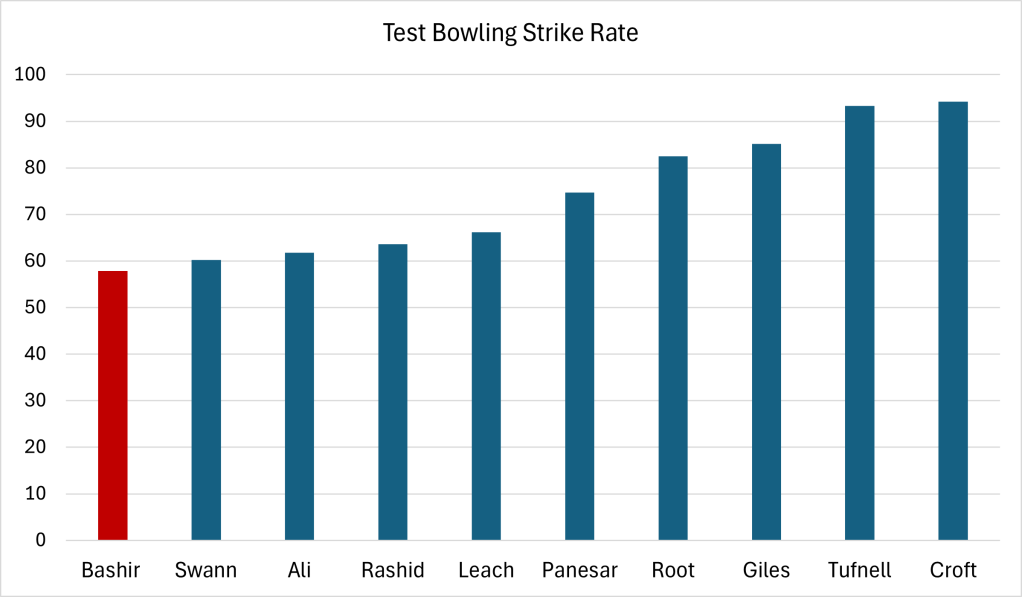
These three charts tell an interestingly complete story. Shoaib Bashir has a mediocre bowling average, not world-beating but aligned with other reliable performers from recent decades. His mediocre average is achieved by the combination of a terrible economy and impressive strike rate. In other words, he’s very expensive but he does take wickets. The wily Robert Croft had a very similar average via the opposite approach – he has the worst strike rate and best economy of the group.
This assessment aligns with what any cricket watchers would observe. Bashir bowls far too many bad balls for a test player, but also shows signs of being genuinely threatening. Many young spinners who put plenty of action on the ball face a similar challenge. Getting wickets comes naturally, but bowling consistently enough to keep control of the game takes years of practice. This is why England’s most successful spin bowler of the modern era, Graeme Swann, didn’t make his test debut until he was nearly 30.
The top-notch strike rate makes Bashir’s position as England’s first choice test spinner at least partly justifiable. However, whether he should already be playing regularly for England also depends on the other spin resources available. A review of county championship performances so far in 2025 tip the balance firmly in favour of an alternative.
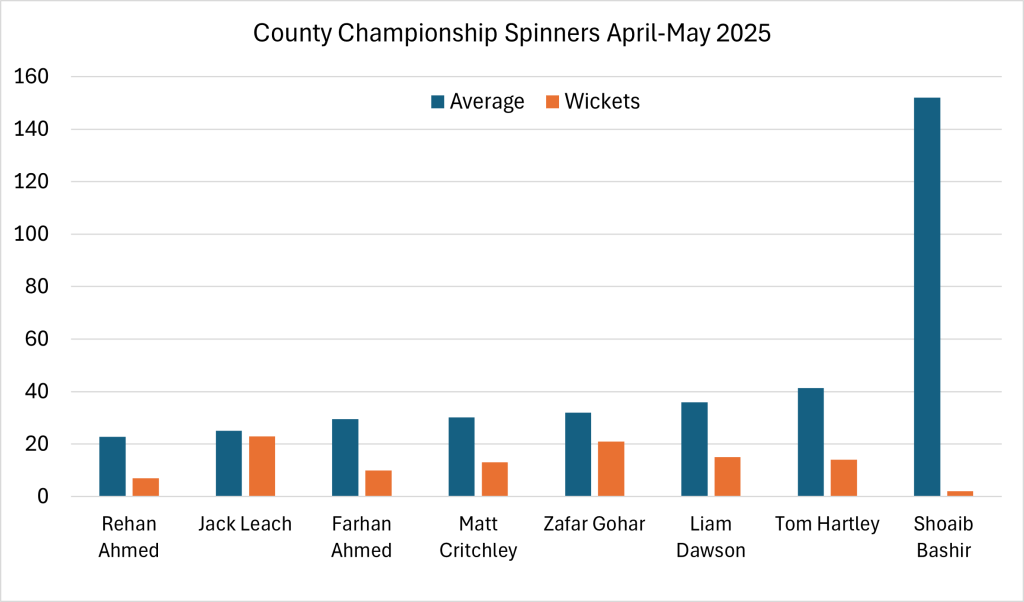
Bashir has the fewest wickets (admittedly in the fewest games) at an abysmal average of over 150. It’s not shown in this graph, but he also has comfortably the worst economy rate at 4.23. If England are after a long-term project, either of the Ahmed brothers would make sense, probably ahead of Bashir. By far the most sensible pick would be Jack Leach, with the added benefit of leaving his space at Somerset open for Bashir.
The England management might argue that statistics don’t tell the whole story, particularly given the recent news that they’ve dismissed two of their key data analysts. They often favour instinct and the way people look over old-fashioned evidence. The trouble is that over a reasonably long period statistics do tell the whole story. The team who scores the most runs always wins. For a team to score more runs than the opposition across the four innings of a test match, their bowlers need to take 20 wickets at a lower average than the opposition. Picking someone with a consistently higher bowling average means consistently losing more games of cricket than you need to. 16 test matches is plenty of time to come to a conclusion on Bashir, and he still isn’t delivering better returns than several alternatives.
There is often something to be said for selecting a cricketer based on potential rather than current ability. Shoaib Bashir is obviously talented and could turn into a top-class bowler. Whether a long-term option makes sense depends on an individual’s likely development period set against the team’s priorities. England’s test match priority is invariably the ashes, with India at home following in a close second. There is no excuse to pick anything but your best team for those series, regardless of future potential. It took Graeme Swann a decade to progress from a wayward young bowler to the best in the world, so it feels improbable that Bashir will get anywhere near in a matter of months.
An added risk for Bashir is that the longer he keeps his place in the team, the harder it will be to return if he does eventually get dropped. He’ll be seen as a failed experiment rather than a youngster who had a brief taste of test cricket, and England will lose a bowler who could otherwise still be playing in 2040. One of county cricket’s main roles is to develop future England players, and it should be developing Shoaib Bashir.
I will update this post in January 2026 once England have played India and Australia, when we’ll know if Stokes and Co were right all along.
* January 2026 Update *
Stokes and Co were not right all along. Bashir injured his finger during the third test against India and hasn’t played a match since, despite being fit. He didn’t play at all in the disastrous Ashes series, which was supposed to be his chance to shine.
Statistics against India in summer 2025 – 3 tests, 10 wickets at 54.10
Current test record – 19 tests, 68 wickets at 39.00
Bashir has now signed for Derbyshire, so hopefully will have a chance to play regularly and develop in a better environment than the 2024-26 England dressing room.
 Chris Hughes Blog
Leave a comment